



Learning from the Land: A Kazakhstani Farmer’s Journey Toward Sustainability
Feb 1, 2026
By Adel Zhaneken, Save Soil Volunteer
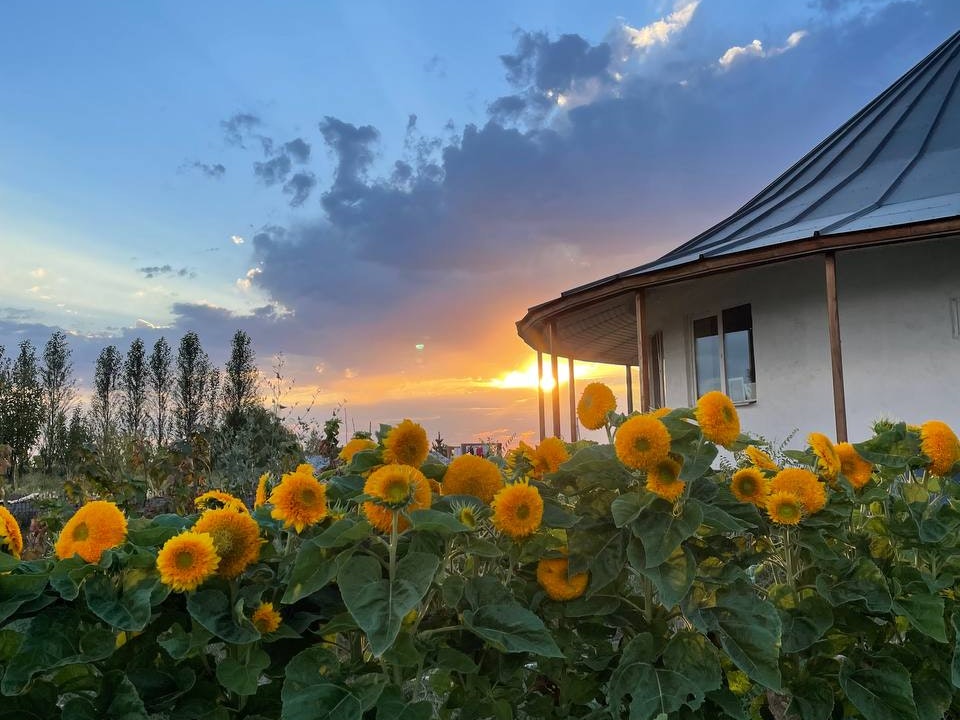
This story is about homecoming – when the longing to reconnect with Mother Earth transformed a city dweller with no prior experience of farming into a passionate permaculturist and educator. “Every week, more than 50 people visit our family eco-farm, inspired to adopt a sustainable way of living.”, says Tayir, a farmer from Kazakhstan, who transformed 2 hectares of land used for monoculture into an eco-farm with a thriving tree system, a vegetable garden, and integrated small-scale goat husbandry. For Tayir, the implementation of permaculture principles was a turning point in his journey to cultivate and form a deeper connection with the land that he bought for his family to live and prosper. Tayir’s desire to share the knowledge that he accumulated over the years of following permaculture land management flourished into educational hands-on experience programs for schoolchildren, and masterclasses for adults, where kids learn to compost and mulch, interact with goats, as well as be introduced to sustainable woodworking, while adults experience living in greater harmony with the land. “My wife and I organize guided tours of our eco-farm for school and kindergarten groups. Children see where food comes from, how to engage with farm animals, how to care for soil using permaculture principles. This is not just a tour – it is an immersion into farm life. The feedback from the community has been positive. We are thrilled to see how involved the children are in the activities we offer on our farm. This inspires us to keep offering various opportunities that develop environmental thinking in the rising generation.”


Agriculture in Kazakhstan: Strategic Importance and Emerging Challenges
According to a 2025 report by OECD, agriculture contributes 4% of GDP in Kazakhstan, which is modest, yet the sector remains strategically important — especially for export (grain) and for rural livelihoods¹ as the country is a major global exporter of grain (wheat, barley, cotton, rice).² Kazakhstan has about 214 million hectares of land suitable for agriculture, representing approximately 75% of the country’s territory, with a substantial area currently under agricultural production.³ However, 29 million hectares are already suffering erosion, leading to lower soil fertility and reduced agricultural output.⁴ Land degradation in Kazakhstan is both extensive and worsening, undermining farmers’ economic viability and food security, especially in rural communities.⁵ Data from the State Institute for Land Survey Work of the Ministry of Agriculture indicate that the soil’s productive capacity has declined by 17% in degraded agricultural lands, contributing to reduced crop yields.⁶ Reduced productivity limits farmers’ income, forcing some to switch crops, reduce cultivated areas, or leave agriculture entirely. Salinization and erosion also increase production costs (more fertilizer and water needed to sustain yields).⁷ Kazakhstan is responding to these challenges with new legislation and ecological programs. Currently, the government is drafting a “Soil Protection Law” to regulate land use and reduce degradation from chemical inputs and misuse of soil.⁸
In addition, the overall share of the workforce in agriculture has dropped over decades to ~12% (2023),⁹ and continues to hover around ~10–11% (2024–2025).¹⁰ According to the Next Generation Kazakhstan survey (based on national labour force data for young people aged roughly 15–35), agriculture is moderately unpopular compared with youth aspirations for other sectors.¹¹ With only 6% of young people selecting agriculture (including forestry and fishing) as their preferred career path, it ranks below top sectors like education (19%) and entertainment (13%).¹² Young people who grow up ecologically conscious and in tune with nature are uniquely positioned to be part of the solution to Kazakhstan’s agricultural and land-degradation challenges. International and national organizations, including FAO, emphasize that young people’s engagement in sustainable agriculture and food systems is critical for climate mitigation, adaptation, and long-term food security, and that youth-led innovation and leadership can drive the transformation of agricultural sectors toward sustainability.¹³
Tayir explains that when young people are introduced early to the idea that humans are deeply interconnected with nature, they grow up with a sense of responsibility for the land, soil, water, and ecosystems that sustain life. In Tayir’s words, this early exposure develops “ethics” in children, which is a level of sensibility to the world around them, in other words, it shapes their values, strengthens their ecological awareness, and guides them toward making more mindful, sustainable choices as adults. For Kazakhstan, where agriculture, land management, and natural resources play an important role in national development, nurturing ecological consciousness from childhood is especially vital. Children who understand soil health today, will become tomorrow’s farmers, scientists, policymakers, and innovators. Their eco-friendly decisions will help build a more resilient agricultural sector, promote sustainable land use, and support the country’s long-term prosperity.


Rethinking Agricultural Development: The Power of Observation and the Potential of Small Farms
Kazakhstan has a dualistic agricultural structure marked by both large-scale commercial operations and smaller farms, with a significant role played by agro-holdings (large vertically integrated agricultural corporations) and state-supported investment projects alongside private and family farming. However, in Tayir’s view “large-scale, government-subsidized agricultural projects often struggle to deliver durable results.” Agro-holdings primarily supply cities; however, they are not self-sufficient and depend strongly on government policy and state support. Rather than prioritising agro-holdings, the focus should be on developing small farms.” Tayir’s goal is to turn his land into a self-sufficient, model farm that demonstrates the benefits of permaculture. Currently, Tayir’s farm produces enough fruits and vegetables to sustain his family. He has recently integrated livestock: the Saneen, a Swiss breed of domestic goats that produce three to four liters of milk per day. Ten liters of milk produces one kilogram of cheese, which the family sells. In the future, Tayir aims to integrate practices such as rotational grazing to create a living example of regenerative agriculture—one that allows visitors to directly experience the power and potential sustainable methods in action. Tayir does not plan to become a big, commercial farmer. In Tayir’s view, “the development of small farms should become a trend, because it is small farmers who have time and resources to produce high-quality organic produce.”

One of the visitors to the farm, an eco-activist Jamilya, shared her experience: “I organized a trip to Tayir’s farm for my son’s school class. During the tour led by Tayir’s family, we learned about zero-waste farming and mulching in a fun, hands-on way, made crafts, and fed the goats. Madina (Tayir’s wife) makes delicious cheese from goat’s milk, which we enjoyed with a wonderful vegetarian pilaf cooked over the campfire. We spent the whole day outdoors, breathing fresh air and enjoying nature together—children, parents, and teachers alike.” An interesting fact that Jamilya remembers from the farm tour is that “it is very windy where the house is located, thus trees like pines and poplars are planted around the perimeter, to shield the fruit trees that are located closer to the center of the landplot. Otherwise the fruit trees don’t take root. The pines and poplars create a microclimate needed for the fruit trees to survive.” Jamilya was inspired to see how Tayir’s family lives self-sufficiently on their own land and runs their farm: “Their way of life motivated me to embrace a similar approach, and we also became good friends and stayed connected.”

Tayir’s journey toward sustainable farming started with a dream of exploring life beyond the urban realities. A successful career in finance and life in the big city could not fulfill Tayir’s longing to connect with Mother Earth. The longing intensified when Tayir met Madina, his future wife, and both felt that living outside the city, on a land of their own, will be of great support to their children. When Tayir's family moved to the village, they faced the problem of land degradation. The plot of land that Tayir bought has a burdensome past – it was used for tobacco farming in the Soviet Union, and years of monoculture practices have led to drastic consequences. Tayir explained, “there were strong winds and very little rainfall. When we relocated no traces of worms were found in the soil whatsoever.” The path to land restoration was one of trial and error. At the beginning, Tayir and Madina planted fruit trees along the perimeter of their land, however, the seedlings didn’t match the soil type, the planting location was awkward, eventually many of the trees withered away, while the trees that grew didn't bear fruit: “Nothing grew or blossomed. For several years, throughout the second half of our 30s, we experimented.”
Tayir’s quest to understand the reason behind soil’s inability to sustain the fruit trees he planted led him towards an online course on permaculture. The key insight that Tayir took away from the practice of permaculture is the principle “Observe and Interact,” which enhanced his perception that soil is alive: “The Soil is alive, and it is important to build a relationship with it. The Soil is not something abstract, but a living entity – I sit and observe the trees, the garden – that’s how I cultivate self-awareness and foster the connection between nature and I.” Soil is alive, and a relationship should be built with it. In Tayir’s experience, “Mother Earth has a very high level of consciousness. Now that I live in constant contact with soil, in my experience I am in ever-present communication with the nature around me. People can communicate with nature like a living person.” An attentive observation of nature leads to an eventual inward turn in a human being. After implementing the principles of permaculture on his farm, Tayir noticed that the quality of soil improved: the soil is now teeming with earthworms. Near the vegetable garden, Tayir planted grass and cover crops as green manure, which enriches soil with living roots, organic matter and nutrients, to protect the soil from erosion, and weeds. Tayir says this is “to drain the soil and for the soil to breathe, because when the soil breathes the plants grow better.”


One of the steps that Tayir took to revitalize the soil on his land was planting native species of trees: “We determined the ratio and species of trees needed to create a sustainable ecosystem: nine fruit trees and ten native trees. We planted a mix of poplars, pines, acacias, tugay and alfalfa for fixing atmospheric nitrogen into the soil, and some nut trees. Our land needed resilient tree species. The effect exceeded our expectations – the trees grew so quickly! All the trees helped each other, creating a stable system.” Tayir further explained that the tree planting location also changed: “First, you must find the center, the core of the land, for my family it is our house, which we built ourselves, only then you begin cultivating the land around this core. I have two hectares of land, so from the center point, which is our house, I was working with six acres at a time. Within two-three years, whatever I planted grew exponentially.” In permaculture this is called a “core-to-edge” planting plan, or permaculture zoning. Tayir draws a parallel between the “core-to-edge” planting plan and humans’ strive for expansion: “When cultivating land, a human needs to be attentive, the same core-to-edge principle is applicable to a human being: first, find the center, the core, look inward, and move from there. The main thing is to observe and reflect.”
Addressing Gaps in Soil Education through Experiential Learning
Tayir shares that the main challenge on his land restoration journey was the lack of both theoretical and practical education in soil science. As a result, the growth and refinement of his connection with his land ignited in Tayir the drive to fill the gap in education, to pay it forward, and make it easier for the rising generation. At first, Tayir and his friends, fellow eco-enthusiasts and landowners, wanted to create an educational project for public schoolchildren. However, the bureaucracy of the local government that Tayir faced was too overwhelming. He then tried to pitch the idea to the main botanical garden in the city, but alas the proposition didn’t pick up momentum. “Then,” he said, “to keep the initiative going, we decided to make use of what we have – our family-farm. We invited the representatives of a famous local private school, and for two years we conducted excursions for schoolchildren practically for free.” Through word of mouth, social media, and positive feedback from parents, children, and teachers, more private schools wanted to get involved, and different people outside the educational sector showed interest in visiting the farm. Slowly this has evolved into an independent project that he and his wife manage. For adults, several masterclasses on green building were designed to satisfy their curiosity on the topic of sustainable living. The future plan is to develop a longer-term educational program that allows children to visit the farm for one to two weeks every three to four months to gain an immersive farming experience.


In Tayir’s view, the way forward in agriculture in Kazakhstan is the establishment of small independent farms, as well as the creation of an accessible educational platform on rotational grazing for farmers with livestock. Kazakhstan ranks fifth globally in terms of pasture area with approximately 187.55 million hectares of pasturelands. Pasture-based livestock production supplies around 90% of the country’s meat, 97% of its wool, and 75% of its milk.¹⁴
Research shows that agricultural ecosystems under livestock grazing are more productive, stable, and resilient when herbage and soils remain biologically functional and continue to perform their essential ecosystem functions.¹⁵ Tayir’s eco-farm serves as a source of inspiration that regenerative methods are understandable, applicable, and of tremendous use to small farmers in Kazakhstan. The desire to reconnect with nature led Tayir to a transformative experience of learning to live on land sustainably. By opening his family eco-farm to visitors, Tayir promotes permaculture and soil health while offering urban children a chance to reconnect with the soil that sustains life. Tayir’s care for soil allowed him to live independently, feed his family, earn a livelihood, and educate others through lived experience. A healthy and productive plot becomes not only a source of food and income, but also a space for learning and knowledge-sharing, where others can see, experience, and be educated in sustainable land stewardship. In this way, soil health supports not only the health of individual families, but resilient communities and long-term societal wellbeing, the foundation of a vibrant population and sustainable national development.
References
¹OECD (2025), Agricultural Policy Monitoring and Evaluation 2025: Making the Most of the Trade and Environment Nexus in Agriculture, OECD Publishing, Paris. https://www.oecd.org/en/publications/agricultural-policy-monitoring-and-evaluation-2025_a80ac398-en/full-report.html
²OECD, Agricultural Policy Monitoring and Evaluation 2025, Kazakhstan chapter.
³OECD, Agricultural Policy Monitoring and Evaluation 2025, Kazakhstan chapter.
⁴Vives, E., Moreno Silva, T., Franco Vega, I., Fras, M., Sharipova, D., & Zhussupov, A. (2025). Next Generation Kazakhstan (British Council report). British Council.https://www.britishcouncil.org/sites/default/files/next_generation_kazakhstan_web_eng.pdf
⁵Food and Agriculture Organization of the United Nations (FAO). (2024, December 20). 90 million hectares of land in Kazakhstan at risk of degradation: Experts propose solutions. FAO. https://www.fao.org/in-action/pesticides-central-asia/news/news/news-detail/90-million-hectares-of-land-in-kazakhstan-at-risk-of-degradation--experts-propose-solutions/en
⁶Ratel.kz. (2025, February 19). Almost 30 mln ha of land degraded in Kazakhstan. Ratel.kz. https://www.ratel.kz/raw/almost_30_mln_ha_of_land_degraded_in_kazakhstan
⁷United Nations Development Programme (UNDP). (2025, March 4). UNDP launches project to enhance agricultural resilience and ecosystem conservation in Northern Kazakhstan. UNDP. https://www.undp.org/kazakhstan/press-releases/undp-launches-project-enhance-agricultural-resilience-and-ecosystem-conservation-northern-kazakhstan
⁸RSE on REM Institute of Parliamentarism. (2024, June 6). A law on soil protection is being developed in Kazakhstan. Institute of Parliamentarism. https://parlaminst-mtqb.qr-pib.kz/en/p/33572
⁹Helgi Library. (n.d.). Employment in agriculture (% of total workforce) — Kazakhstan. https://www.helgilibrary.com/indicators/employment-in-agriculture-as-of-total-workforce/kazakhstan
¹⁰Qazinform. (2025, January 9). Over 7 million people employed as wage workers in Kazakhstan. Bureau of National Statistics, Agency for Strategic Planning and Reforms of the Republic of Kazakhstan. (2025, November 14). The situation on the labor market (III quarter 2025). https://stat.gov.kz/en/industries/labor-and-income/stat-empt-unempl/publications/462422/
¹¹Vives et al., Next Generation Kazakhstan (British Council, 2025).
¹²Vives et al., Next Generation Kazakhstan (British Council, 2025).
¹³Food and Agriculture Organization of the United Nations (FAO). (2025, August 23). FAO Kazakhstan highlights environmental protection, food security, and youth engagement at the Local Conference of Youth on Climate Change 2025. FAO. https://www.fao.org/countryprofiles/news-archive/detail-news/en/c/1741956/
¹⁴Livestock grazing technologies as the leading factor in preserving the quality of pasture ecosystems. (2025). International Journal of Agriculture and Biosciences. https://www.ijagbio.com/pdf-files/25-328.pdf
¹⁵Livestock grazing technologies as the leading factor in preserving the quality of pasture ecosystems. (2025). International Journal of Agriculture and Biosciences. https://www.ijagbio.com/pdf-files/25-328.pdf

LET US MAKE IT HAPPEN!